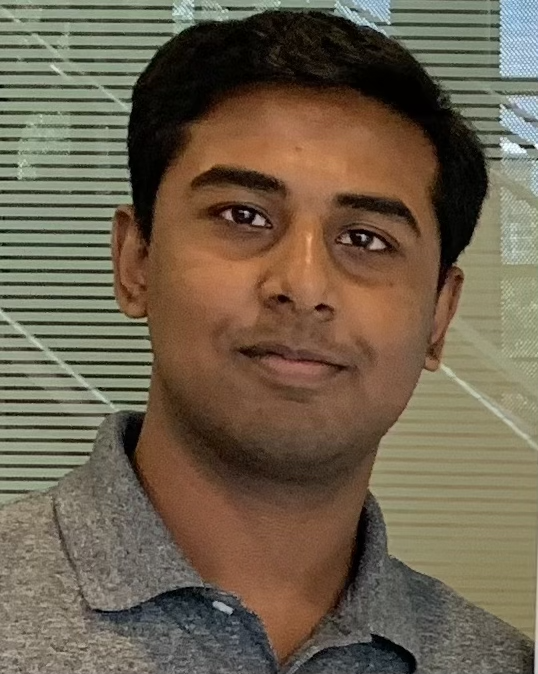
About Me
I am a third-year PhD student in the Computer Science department at the University of Texas at Austin, where I am advised by Scott Aaronson and Nick Hunter-Jones. I am broadly interested in quantum computing and theoretical computer science. I’m affiliated with UT’s Theory Group and Quantum Information Center, and supported by a TQI Graduate Fellowship.
I previously graduated from the University of Massachusetts Amherst with a B.S. degree double majoring in computer science and mathematics. During my undergraduate, I worked under Don Towsley as part of the ACQuIRe Lab at UMass. I recently spent a summer interning at Visa Research in their quantum computing team, and prior to that I was a research fellow at Los Alamos National Laboratory, as part of their Quantum Computing Summer School Fellowship.
Selected Papers
See Research for a full list. Authors are listed in alphabetical order for the first paper here.
Sabee Grewal, Meghal Gupta, William He, Aniruddha Sen, Mihir Singhal
FOCS 2026
(arXiv)
Abstract
We give an algorithm for pure state tomography with near-optimal copy and time complexity using only single-qubit measurements. Specifically, given \(\widetilde{O}\left(\frac{2^n}{\epsilon}\right)\) copies of an unknown \(n\)-qubit pure state \(\lvert \psi \rangle\), the algorithm performs only nonadaptive Pauli measurements, runs in time \(\widetilde{O}\left(\frac{2^n}{\epsilon}\right)\), and outputs \(\lvert \hat{\psi} \rangle\) with fidelity at least \(1 - \epsilon\) with \(\lvert \psi \rangle\) with high probability. This is the first algorithm for pure state tomography that achieves near-optimal running time.Aniruddha Sen, Nick Hunter-Jones
Preprint (2026)
(arXiv)
Abstract
Porter-Thomas statistics are a characteristic feature of the output distribution of random quantum states and, more broadly, chaotic quantum many-body systems. Convergence to Porter-Thomas plays a central role in random circuit sampling and experimental demonstrations of quantum advantage, where the output statistics of low-depth random quantum circuits are expected to be approximately Porter-Thomas, despite the absence of a rigorous proof of convergence. We show that the output distribution of polynomial-depth brickwork random circuits converges inverse-polynomially in total variation distance to the Porter-Thomas distribution. Specifically, consider the output probability distribution over a fixed bitstring of a local random quantum circuit, constructed from nearest-neighbor Haar random gates. Then, for any \(m \ge 0\), the distribution corresponding to circuits of depth \(O(n^{2m+1} \log(n))\) is at most \(O(1/n^m)\) far in total variation distance from the Porter-Thomas distribution. Our proof uses moment bounds from approximate designs, analytic estimates for characteristic functions, and a local anticoncentration property for inverse moments.Aniruddha Sen
Preprint (2026)
(arXiv)
Abstract
We study the problem of tomography for \(k\)-sparse quantum states. In contrast to classical distribution learning, where tight sample and time complexity bounds in terms of support size are well understood, no non-trivial bounds were previously shown for this problem. We give the first near optimal algorithm for learning \(n\)-qubit \(k\)-sparse pure quantum states, obtaining fidelity at least \(1−\varepsilon\) with high probability using \(\tilde{O}(k/\varepsilon)\) copies of the state and \(\tilde{O}(kn/\varepsilon)\) time. Both bounds are optimal up to polylogarithmic factors. As an implication, we also obtain an algorithm with near optimal \(\tilde{O}(kr/\varepsilon)\) sample complexity for learning \(k\)-sparse rank-\(r\) mixed states, via the random purification channel technique. Obtaining time complexity nearly matching the sample complexity, for \(r>1\), remains an important open question.Maxwell West, Frederic Sauvage, Aniruddha Sen, Roy Forestano, David Wierichs, Nathan Killoran, Dmitry Grinko, M. Cerezo, Martin Larocca
QTML 2025
(arXiv)